
From Manuscript to Paperback
The last mile problem for publishing and how I solved it for good.

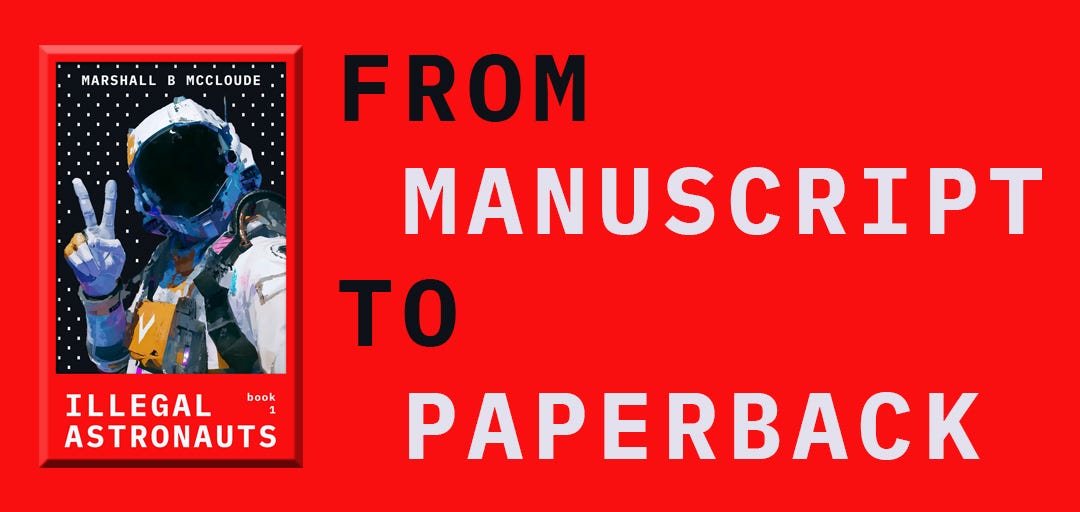
Let’s say you’ve just finished your latest novel like I have. You’ve spend months, maybe years, getting the words down on the page through consistent editing cycles and it’s finally ready for prime time. But, as soon as you go to try to publish it, you find that you’ve actually got to convert that document into a precisely formatted EPUB and print-ready PDF.
Unfortunately, there’s really no good tools for this. Calibre, Sigil, and Atticus are all manual toolsets that help manage the production of EPUBs, but, unfortunately, Calibre and Sigil are old software and lack modern efficiency. Meanwhile, Atticus is more platform than automation tool.
To make matters worse, when it comes to PDFs, the only real tool on the market is Adobe Acrobat. An expensive piece of software that’s frustrating to operate, poorly documented (despite what your Adobe representative might tell you), and provides no useful automation tools.
So, to get my novel Illegal Astronauts off the ground, I realized I’d have to make my own software. Good thing I’m a writer and a software engineer.
To do this, I first converted my manuscript into Markdown (.md) format. In doing so, it became very clear that the Markdown format is actually a fantastic way to foster a distraction free writing environment. One that’s bolstered even more when paired with purpose built tools like Obsidian.md (it’s free).
The next step was to convert the Markdown format manuscript into HTML. The Markup Language you’d find on every single user facing website out there. This is actually quite trivial as Markdown converts one to one into HTML.
From there was the hard part: converting the HTML version of Illegal Astronauts into the EPUB and print-ready PDF formats. Which is where the Python scripting language came onto the scene.
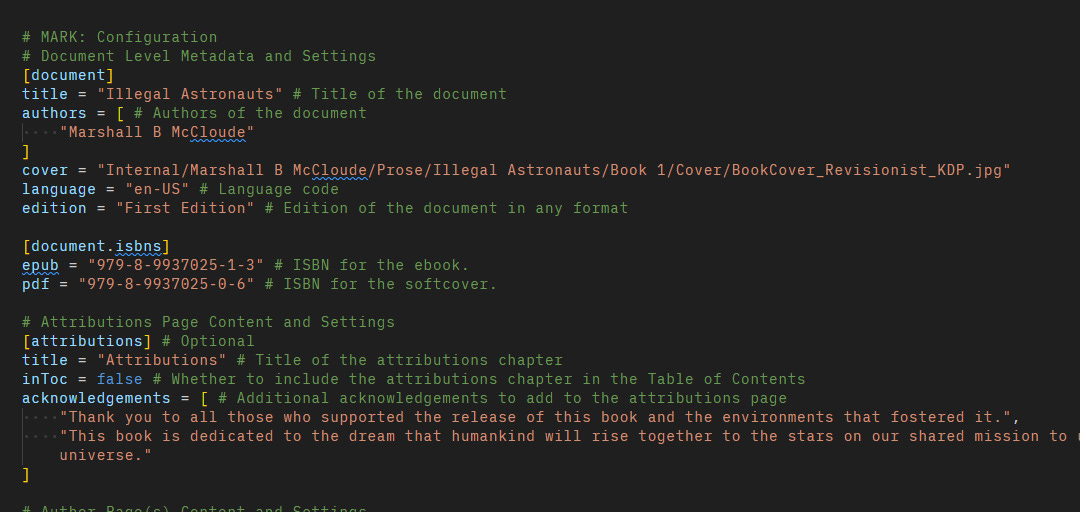
To keep it concise, I implemented a YAML-based configuration file that informs the Python script of how to render the EPUB and print-ready PDF files. When combined with the code I wrote, this configuration file and manuscript can be converted into the desired publishing formats with a single command.
The best part: the process is infinitely repeatable, deterministic, and produces consistent, publisher-ready outputs of full length documents (we’re talking more than 72,000 words) in less than a second. A process that takes traditional publishers anywhere between a few days all the way up to five months to complete.
The way I see it, this is just another step to producing a real workflow, not a series of manual steps, that will allow writers to focus on writing, and not the technical labor required to take their next masterpiece to the market.
You can see for yourself how great this workflow is for yourself on January 2nd, 2026: National Science Fiction Day and the long awaited release of Illegal Astronauts Book 1.
And, if you’d like to try the tool out on your own up and coming best seller, let me know. The Wülfridge Exeter Publishing Division is now open for business.
P.S. I had planned for this post to be a video but I couldn’t get it done on time. No promises, but if nothing else comes up and I can get it working the way I want, you just might have that in your future!